Force Diagrams
A force on an object can push in any direction, and when we add those forces together to try to find out if they are balanced, we want to be aware of the direction of each force, as will as its strength. So, of course, we will represent forces using vectors.
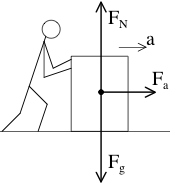
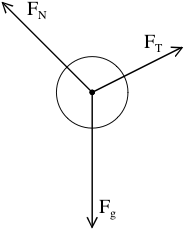
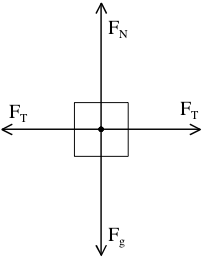
One thing you will be doing throughout this unit is drawing a force diagram for an object, showing the strength and type of every force acting on it. When you do this, draw all the force vectors so that they start at the center of the object; this makes it easy to identify what are all the forces on an object. You should also label each vector with the symbol for its force type, and with the strength, if it is known, of that force.
The types of forces we know so far are:- The weight, or force of gravity Fg, which always points down and is equal to Fg = mg, where g = -9.8
 is the strength of gravity on Earth.
- The normal force, which always points away from where two objects touch, and is as strong as it needs to be to keep them from going through each other.
- An applied force, which comes from something pushing the object.
- A tension force from a rope or string, which always points out along the string and is strong enough to keep the string from stretching further.
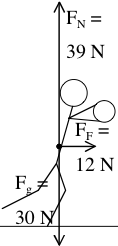
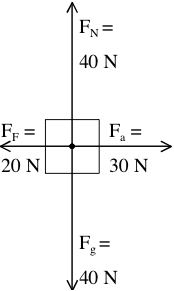
- For each of the force diagrams to the right:
- Find the the net force vector.
- Find the mass.
- Find the acceleration vector.
- I am pushing a 8 kg box across the ground. I am pushing with a force of 30 N, which is just enough to counteract friction and keep the box going at a constant rate. Draw a force diagram for this situation, and find the vector form of each force.
- Looking at the force diagrams to the right, draw in surfaces and ropes to show what sort of things are exerting force on the object.
Remember, a normal force always pushes away from where two objects are in contact, and a tension force always points along the rope.
- A 20 kg box is being lifted by a rope. It has yet to leave the ground. The tension force in the rope is 125 N. Draw a force diagram for this situation, and find the vector form of each force.
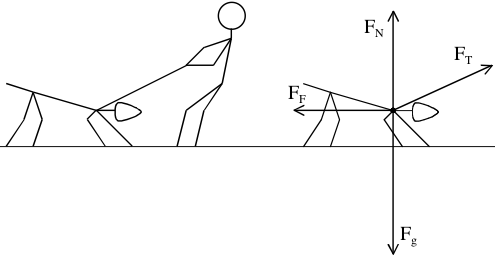
- Just like in linear motion, a vector need not be straight along one of the axes. In the situation below, the man is pulling the dog's leash at an angle, but the dog won't budge. The tension force in the leash is FT = 100
 + 25. The dog's mass is 20 kg. Find the strength of all the other forces on the dog.
Answers: 1)  = .25 m/s², = (4 + 3) m/s²